Building Resilience with Zero trust, ISO Certs, and CMMC Readiness
ArvataLogix, a strategic advisory firm that is forward-thinking, acknowledged the growing necessity for a comprehensive cybersecurity program to safeguard its assets and prepare for future opportunities in the public and defense sectors. The company is fully certified and compliant with ISO 27001 (Information Security Management) and ISO 28002 (Resilience Management Systems). Additionally, ArvataLogix initiated a proactive initiative to improve its credibility and client assurance by aligning with CMMC Level 2 and NIST 800-171.
Objectives
- ArvataLogix had to adopt Zero Trust principles as a modern security framework and aligning internal processes with CMMC Level 2 preparedness.
- In order to satisfy the requirements of NIST 800-171, ArvataLogix was required to provide documentation and conduct a Supplier Performance Risk System score.
- The Information Security Officer of ArvataLogix integrates the existing ISO controls with the organization’s overarching compliance objectives.
- ArvataLogix had to demonstrate security leadership and operational resilience.
Implementation Details
Zero Trust Approach
Recognizing the evolving threat landscape and the limitations of perimeter-based defenses, ArvataLogix made the strategic decision to adopt a Zero Trust security model. This marked a cultural and operational shift, moving from implicit trust to a framework where all users, devices, and systems must continuously earn access based on identity, context, and risk. The company began its journey by establishing clear identity and access policies, implementing multi-factor authentication, and segmenting its internal network to limit exposure. As the initiative progresses, Zero Trust is being embedded into infrastructure design, access workflows, and employee behavior, laying a foundation for adaptive, resilient security at scale.
Key Implementations included:
- Identity and Access Management: ArvataLogix deployed Multi-Factor Authentication (MFA) across all user accounts to require a second layer of identity verification. They also implemented Single Sign-On (SSO) using a trusted identity provider, allowing employees to securely access all internal applications through one central login. Strong password policies were enforced, including expiration cycles, complexity requirements, and password reuse prevention.
- Network Micro segmentation: The company segmented its internal network into logical zones using VLANs and firewalls, ensuring that users and systems only had access to the specific data and applications necessary for their role. This minimized the impact of any potential breach by containing threats to isolated zones.
- Device Compliance: Only company-managed devices that met security baselines (such as OS updates, endpoint protection, and disk encryption) were allowed access to internal systems. A mobile device management (MDM) platform ensured continuous compliance monitoring.
- Continuous Monitoring: ArvataLogix implemented Endpoint Detection & Response (EDR) tools that provided real-time visibility into device behavior and potential threats. Centralized logging aggregated system, network, and access events to a secure SIEM platform, allowing for anomaly detection, alerting, and forensic investigation.
ISO 27001 and 28002 Integration
Leveraging ISO certification gave ArvataLogix a head start in control maturity:
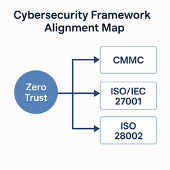
- ISO 27001 policies were extended to map to NIST 800-171 controls
- ISO 28002 is a natural complement to cybersecurity efforts, as it concentrates on resilience management, which assists organizations in preparing for, responding to, and recovering from disruptive events
- Internal audits and risk assessments were formalized and repeatable
- Employee security awareness programs aligned with international standards
Aligning with NIST 800-171 / CMMC
- Created a System Security Plan (SSP) with mapped controls
- Developed a POA&M for controls in progress
- Applied encryption for sensitive data at rest and in transit
- Enabled secure remote access through VPN + MFA policies
Challenges and Lessons Learned
- Challenge: Harmonizing multiple standards without duplication
- Solution: Mapped ISO, CMMC, and NIST controls into a unified policy framework
- Lesson: Certifications provide more than compliance—they strengthen business resilience and trust
Business Impact
ArvataLogix experienced measurable improvements:
- New opportunities in defense and critical infrastructure sectors
- Improved client trust and shortened security questionnaire cycles
- Faster response time to incidents due to improved visibility
- Cross-functional awareness and ownership of cybersecurity practices
Key Takeaways
- Zero Trust and ISO standards together create a powerful compliance and resilience stack
- CMMC alignment is a strategic differentiator—even before full certification
- ISO 27001 and 28002 provide scalable frameworks for long-term security growth
- Integrating standards reduces overhead and improves operational clarity
Next Steps
ArvataLogix initiated alignment with CMMC Level 2 and is currently preparing for formal assessment. This is occurring in conjunction with the ongoing efforts to improve security metrics reporting, enhance internal automation, and further align with the moderate baselines of FedRAMP for future SaaS offerings. Additionally, the organization is creating templates and toolkits to facilitate the efficient implementation of comparable frameworks by its customers.
Get in Touch
Have a question or want to learn more about working ArvataLogix? Reach out and a member of our team will follow up with shortly.